

If your brand moved cities, would anyone notice?
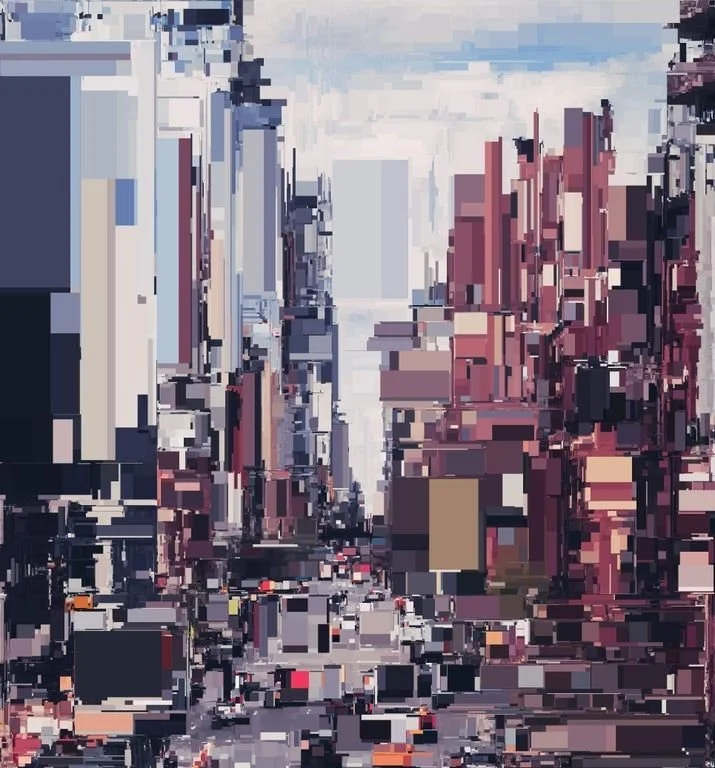
You spot it first when you travel somewhere you were excited to see, somewhere you imagined would feel different, and it does not. The airport could be anywhere, with the same gates, the same shops and the same announcements echoing off the same polished floors. The motorway feels like a generic AI image of ‘Motorway’, lined with the same billboards, the same chain restaurants and the same office buildings, set back from the road at the same distance. Even the hotel reception, with its generic artwork arranged in the corridors to suggest authenticity, could be anywhere once you look past the staging. You find something to do, maybe you visit the big new shopping centre. That vast climate-controlled metropolis of consumption that places like Dubai have perfected into something almost terrifying. You are in a place that has been designed to feel like no place at all, a space stripped of accident and history and everything that makes a location recognisable as itself. The soullessness is not a bug but a feature, not an oversight but the entire point. The priority is capital, not happiness. You are not meant to linger here. You are meant to move, to consume, to return to your car and drive to the next consumption point, and the architecture does not lie about its intentions.
The Romans, who thought deeply about such matters, had a concept they called Genius Loci. The spirit of a place. Every location, they believed, had its own protecting deity, its unique character that demanded respect from those who would build upon it. When you construct something new, you build with that spirit, not against it, or else you invite the slow haunting that comes from ignoring what was there before. The Egyptian architect Hassan Fathy spent his entire career arguing something similar, though his language was more practical. He believed one must build only with materials found in the land, that importing resources from elsewhere should never be the first thought when designing for a community. For Fathy, this was not nostalgia dressed up as principle, but rather integrity towards the place itself. Modern architecture that rejects its ‘place‘, importing everything from elsewhere, builds something that belongs nowhere and speaks to no one.
This feeling of sameness has crept from our cities into our language with an efficiency that should trouble anyone who works with words. The brand emails that could be from any company, written in a voice so thoroughly average it might as well be written by our favourite corporate chatbot. We have built a global architecture of communication, and it is just as hollow as the glass and steel around us. When we import tropes without understanding the local soil, we build pastiche rather than presence. The words look right on paper, they pass every brand guideline test, but they feel wrong in the air. The audience scrolls past, not because they have rejected the message, but because the message never quite reaches them. It arrives wrapped in a foreignness they cannot name but can always feel. The question is whether understanding why our cities feel empty might help us understand why our marketing feels empty too, and whether the lessons of place might show us a way back to something more human.
Consider Red Bull, which by every conventional research metric should have failed so spectacularly that its name would be remembered only as a cautionary tale told in marketing textbooks. Tiny can. High price. Disgusting taste. Rory Sutherland of Ogilvy has made this point many times, and it bears repeating because the lesson is so easily forgotten. The research said no, emphatically and repeatedly, and the research was wrong. The product succeeded because it understood something deeper than feature sets and benefit statements. It understood the cultural logic of energy, of transgression, of the strange medicinal allure that also built Coca Cola and coffee into global habits rather than passing fads. Red Bull did not import a message that worked elsewhere and hope for the best. It found the current already moving in the culture and plugged into it with remarkable precision. Their message was simple and it stuck, repeated until it became true through sheer force of presence. Red Bull gives you wings. They had the budget to make that repetition possible, but the lesson is not about budget. It is about understanding the soil before you plant, about reading the landscape accurately enough to know where water already flows.
This is where urban planning offers its clearest and most urgent lesson. Look at China, where cities are not accidents of history or economics but deliberate expressions of something deeper. Chinese urban planning reflects a cultural logic of harmony, hierarchy, and collective orientation that has persisted through dynasties and revolutions. The traditional courtyard houses, the siheyuan (四合院), arranged themselves around shared space rather than private. The architecture itself reflects a collective social mindset, with space organised around shared principles rather than private convenience, and each dwelling positioned to serve not just its inhabitants but the order of the community beyond its walls. Public space in China is designed for ordered flow, not spontaneous congregation. It reflects a culture that values stability and structure, that places the collective above the individual as a matter of course.
Marketing that works in China understands this at a level deeper than strategy. It does not celebrate rebellious individualism in the Western sense, does not champion the lone voice against the crowd, because that story does not resonate in a culture built on different foundations. Instead it frames products as tools for family cohesion, for social harmony, for collective progression. A luxury brand in China does not stand out from the crowd. It sells belonging to an elevated class within it. The messaging is aspirational but within a collective framework that honours the existing logic rather than fighting it. Consider the Chinese New Year campaigns from brands like Burberry or Gucci. The ones that work show multi-generational families gathered in warmth, respect for tradition woven through the imagery, nods to local symbolism like the zodiac animal rendered with care rather than condescension. The ones that fail simply transpose a Western campaign and add red envelopes, hoping the colour will do the work that understanding should have done. They build with foreign materials and wonder why the structure feels wrong, why the response never comes.
French urban planning, particularly in Paris, reflects a logic of order and legibility that speaks to deeper cultural values. Haussmann's boulevards were not just aesthetic improvements to a medieval city. They were about surveillance, about flow, about the assertion of state power over the unruly chaos of the unplanned. But beneath that grid lies something else, something that survives all attempts at rationalisation. The quartier. The village within the city. Agnès Varda's Daguerreotypes documents the Parisian communities that depended on small businesses and the local high street on Rue Daguerre. In the film, residents shop locally, returning to the same places each day and interacting with familiar faces. Much has changed since the documentary's release in 1976, but the principle remains the same. French urbanism balances the grand gesture with the intimate scale, the national with the local, the universal with the particular. It expects beauty as a public good, as something owed to citizens rather than reserved for the wealthy.
French consumers respond to campaigns that honour this duality, that understand the tension and work within it rather than pretending it does not exist. They appreciate the grand gesture of a luxury brand but demand that it also understand the local, the artisanal, the terroir that gives French culture its particular texture. Successful campaigns in France speak the language of craft, of heritage, of the specific region from which a product comes. Look at how French dairy brands like Président or Yoplait market themselves, the images they choose, the stories they tell. They lean heavily on specific landscapes, on farmers who look like they have been farming for generations, on traditions passed down through families rather than manufactured by agencies. They sell the place as much as the product, knowing that in France the two cannot be separated without losing something essential. When a global brand ignores this and runs a generic European campaign, the French audience can tell the difference.
The pressure to flatten everything into sameness is real and it is economic, and pretending otherwise helps no one. Globalisation made it easier for corporations to reuse buildings with only minor modifications, to take what worked in one location and drop it into another with barely a glance at the surroundings. Why design something new for each location when you can tweak a template and call it done? That is why we stopped making buildings for brands in unique shapes, why the architecture of commerce became so forgettable. Architecture became functional, not artistic. The pattern repeated in marketing, driven by the identical economic logic toward an equally dispiriting conclusion. A/B testing replaced the willingness to say something that might fail, that might offend, that might actually be remembered. The result is the homogeneous digital landscape we scroll through daily, where every brand sounds like a slightly adjusted version of the same bot, and where nothing sticks because nothing is designed to. We have become scared to take risks.
The poet Derek Mahon wrote about "a careful genius loci" in his poem A Disused Shed in County Wexford, and the phrase has stayed with me since I first encountered it. The idea that places hold memory, and that memory, if ignored, will haunt us in ways we cannot predict and may not recognise until it is too late. In marketing, ignored memory is the cultural context we erase when we paste a global campaign onto a local market without adjustment or understanding. It haunts us as consumer indifference, as the slow erosion of response rates, as the quiet failure that never quite announces itself as failure. People do not say why they scroll past. They just do, and the metrics decline, and the reports are written, and no one connects the numbers to the deeper problem.
Sometimes a campaign gets this right, and the difference is immediately apparent. Consider Glenmorangie's recent collaboration with Harrison Ford, which understands how to honour a place while selling a product. For LVMH, the parent company that acquired Glenmorangie in 2004, the timing was useful. The spirits industry has faced a downturn in recent years, and distinctive work that cuts through matters more when the market tightens. The conceit of the campaign is simple. Ford travels to Scotland to shoot what appears to be a clichéd whisky advertisement, complete with mountains and lochs and castles and bagpipes, everything we have been taught to expect from Scotch marketing. The director, Joel Edgerton, lets Ford mock the whole enterprise, subverting the clichés by acknowledging them with cynicism. The audience is in on the joke. He rejects the action hero treatment that his career has been built on. He wants only to curl up by a fire in a Scottish castle and enjoy a glass of single malt, to be present in the place rather than performing for it. The result is an irreverent take on whisky advertising, but beneath the humour lies something more considered.The campaign works because it understands that the usual signifiers have been exhausted, and that the only way forward is to acknowledge the exhaustion. Not that the campaign escaped criticism. According to the Daily Record, Scottish kilt makers questioned why the task of creating kilts for the advert went to an English firm. "If a kilt is being made they should be seeking a Scottish kilt manufacturer," said Iain Hawthorne of Daiglen of Scotland. "They use fine Scottish water, we use fine Scottish wool." The complaint is reasonable and points to the gap that always exists between representation and reality. Yet, the campaign understands Scotland deeply enough to play with the tropes, to acknowledge them and work around them. It builds from something specific, from the character of the place and the product, and the result feels like it comes from somewhere.
The deeper question, the one that lingers after the campaign metrics are tallied and the reports are filed, is not just about effectiveness. It is about what kind of world we are building through our accumulated choices. When we strip marketing of its local voice, when we smooth away the rough edges of regional difference, we participate in a form of cultural erosion that is difficult to measure but impossible to deny. We teach people that the global is more valuable than the local, that imported language carries more weight than vernacular speech, that the specific character of a place is an obstacle to be overcome rather than a resource to be honoured. The ethical marketer must ask not only what sells this quarter, but what kind of environment they are constructing through their daily work. Are we building a world of meaningful difference, rich with particularity and surprise, or a world of interchangeable glass towers and undistinguishable ads? When every city looks the same and every message sounds the same, the campaigns companies spend millions on have no effect. Nothing matters because nothing is different.
Our job, those of us who work with words for a living, is not to import a voice that worked somewhere else and hope it translates. It is to find the one already present in the place and amplify it honestly, to build with the materials the land provides rather than importing everything from elsewhere. That is the lesson from architecture, from the long struggle to build meaningfully in a world that prefers templates. Build with what the land provides. Honour the genius loci and the words will follow.

